New Features

Follow new updates and improvements to Arihant Plus.

September 3rd, 2026

Dear Investors,

Over the last few years, how often our customers apply for IPOs has changed far more than the tools they use to do it. What used to be an occasional thing has become routine mainboard issues, SME issues, REITs, sometimes several in the same week during a busy season.

What hasn't changed is how much running around a single application takes. You find the issue in one place, read about it somewhere else, work out the lot maths yourself, place the bid, switch to a different app to approve a mandate, and eventually end up on a registrar's website to find out whether you got an allotment. We've heard a version of this from customers repeatedly, and the sharpest one stuck with us: "I applied. I think. I'm not really sure what happened after that."

That gap between applying and knowing is what we set out to close. So we rebuilt the IPO section end to end rather than adding to what was already there. Here's what's now live.

How to find it

Open Arihant Plus and tap the IPO icon on your Dashboard. When an IPO is open, the icon carries a badge with the number of open issues, and a Live tag appears on My Accounts. Inside you'll find three tabs Explore for issues you can apply to, Orders for applications you've placed, and My IPOs for issues you've been allotted plus a toggle at the top between IPOs and NCDs.

1. Explore every IPO, by state

The Explore tab groups issues into Open, Upcoming and Listed, each with a count on the chip, with Recently Closed listed below. No hunting to work out which issues are still live.

Each card shows the company name and logo, the closing date, price range, minimum investment, the subscription multiple, and a board tag so you know whether you're looking at a Mainboard, SME, Mid-Cap or REIT issue. On the final day of bidding, the card reads Last Day rather than showing a countdown. Open issues carry an Apply button, upcoming ones carry Pre-Apply.

Where our research team has a view on an issue, the card carries an IPO Recommended by ArihantPlus strip with a View Report link that opens the full report.

At the bottom of Explore sits a Need Help? row with short videos on how to apply for an IPO and how to approve a mandate written mostly for anyone applying for the first time.

2. Key Details, and the Retail/HNI toggle

Tap any IPO and the page opens on Key Details: bidding dates, price range, lot size, issue size, the DRHP, and both minimum and maximum investment. Each investment figure carries the lot and share count behind it, so ₹20,000 shows as 1 lot / 20 shares and ₹2,00,000 as 10 lots / 200 shares. You don't have to do that arithmetic yourself any more.

There's a Retail / HNI toggle on the Key Details card. Switch it and the minimum and maximum investment change to that category's limits, so you can see what applying as an HNI actually requires before you get anywhere near the bid screen.

The status pill at the top tells you where the issue stands Open to Bid with the closing date and time, Last Day, or Closed alongside the current subscription figure.

3. One page, four jump tabs

Below Key Details sit four tabs Overview, Strengths & Risks, Financials and Peers. They're not separate screens. It's one continuous page, and the tabs jump you to the section you want while staying visible as you scroll, so you can read the whole thing top to bottom or go straight to the part you care about.

What's on it, in order:

  • Important Dates: the four dates that matter most, shown as a progress timeline: IPO opening, IPO closing, allotment finalisation and listing date, with the completed ones marked. View Full Timeline opens the complete sequence, including refund initiation and demat transfer.

  • Application Categories: Retail and High Net Worth Individual, with the investment band for each.

  • About Company: the business description, plus the managing director's name and the year the company was founded.

  • IPO Objectives: what the company says it intends to do with the money raised.

  • This IPO is flagged for a short list of value-based flags on the issue. More on this below.

  • IPO Review Videos a carousel of short-form reviews on the issue, dated.

  • Blogs — our written pieces on the issue, with read times, for anyone who'd rather read than watch.

  • Strengths and Risks — the case for and against, in two clearly separated blocks.

  • Financials — revenue, total assets and profit charted year on year, switchable between the three.

  • Recommendations — our research team's written view on the issue, where we have one.

  • Peers — a comparison table against listed peers on P/B, P/E, RoNW and revenue, with View All for the full set.

  • FAQs — an expandable list of the questions we get asked most about the issue.

The Apply button stays pinned at the bottom the whole way down, so you never have to scroll back up to act on what you've just read.

4. "This IPO is flagged for"

This one's new and worth calling out on its own.

Some investors screen issues on grounds that have nothing to do with financials — ESG standing, or whether a business is involved in activities they'd rather not fund. That information is usually buried somewhere in a 400-page prospectus, if it's findable at all.

So we surface it as a short set of flags on the issue itself. These are descriptive, not a rating and not a recommendation: they tell you what a company does, and what you do with that is entirely your call.

5. Subscription, in detail

The subscription multiple on its own doesn't tell you much. A 4x issue where retail is undersubscribed and institutions are heavy is a different picture from the reverse.

So tapping the subscription figure opens a Subscription Rate breakdown showing each category separately — Retail Individual Investors, Qualified Institutional Buyers, Non Institutional Investors — alongside the total. Until subscription data comes through, the field shows --- rather than a zero, so there's no confusion between "not subscribed" and "not yet reported."

6. Ari AI on the IPO page

Ari AI, our in-app assistant, is available directly from the IPO detail page — both from the button at the top of the screen and from a Try now card partway down. You can ask questions about the issue in front of you and get a quick read back, without leaving the page or piecing it together from four sections yourself.

Ari AI is something you choose to open. It doesn't run on its own, it doesn't act on your account, and it can't place or modify a bid. Anything it tells you about an issue is analysis, not advice — the decision, and the Apply button, stay yours.

7. Bidding, with up to three bids per application

This is the part we spent the longest on.

Pick your category from the chips at the top — Retail, HNI, Employee or Shareholder — then set quantity in lots and either enter a bid price or tick At cutoff price. If you enter a price outside the band, the field tells you the valid range instead of failing at submission.

You can add up to three bids on the same application, each with its own price and quantity. The Total Amount at the bottom updates as you add them, and there's an explainer on the calculation: for a single bid it's your bid price multiplied by shares, and where you've placed multiple bids the amount is based on the highest.

A note on why three: SEBI permits up to three bids per application, and we've exposed all three rather than defaulting you to one. Worth knowing before you use all of them — multiple bids block funds against the highest, not the average.

8. Multi-category application

If you're eligible under more than one category — Retail and Employee, or Retail and Shareholder — you can now apply in each of them for the same issue.

After your first application, the IPO page names every category you've already applied in, and the Apply CTA stays active until you've used all the ones you're eligible for. No guesswork about what you've already done, and no accidental duplicate in the same category.

To be clear on one thing, because it does come up: applying in more categories does not improve your chances of allotment in any single category. It only means you're not leaving an eligibility unused.

9. UPI and the mandate

Choose a UPI ID from the ones already on your account, or add a new one inside the flow. The UPI ID needs to be linked to a bank account verified for IPO applications, and we've put that note on the screen rather than leaving you to discover it at the mandate stage.

Once your bid goes to the exchange, the mandate request follows, and the confirmation screen names the app it's landed in and the exact amount to be blocked — so you know to check PhonePe for a request of ₹26,000, rather than hunting through three apps for something unspecified.

There's a How to approve mandate explainer available at every stage, with the actual steps: open the UPI app linked to the ID you applied with, go to the pending requests or mandates section, find the collect request from NPCI for that amount, and approve it with your UPI PIN.

One thing we've put in writing on that screen, deliberately: an IPO mandate only ever blocks funds. It never debits and never credits money to you. If a request ever asks you to receive money in connection with an IPO, do not approve it. That's not how the process works, and it's a pattern worth recognising.

The mandate itself has to be approved on your UPI app — that part isn't ours to move. What we can do is make sure the deadline, the amount and the app all reach you on screen at the moment you apply, instead of in a notification you might scroll past.

10. Orders: Status and Summary

Every application opens on two tabs.

Status is the timeline. It shows what's happened and what's still ahead, with future steps greyed until they're reached: applied on Arihant Plus with the bid count and timestamp, application sent to the exchange, mandate sent with its approval deadline, mandate approved, allotment result date, and listing date. You can see at a glance which step you're waiting on, and whether it's waiting on you or on someone else.

Summary is the paperwork. Current status, category, a copyable application number, each of your bids broken out individually with shares and price, application and allotment dates, and the UPI ID used. Once allotment is out, it also carries lots applied versus lots allotted, amount applied versus amount allotted, and the blocked amount.

While an issue is still open, Modify and Cancel sit at the bottom of both tabs, with a confirmation step before anything is cancelled.

The Orders tab itself filters by status, so during a busy week you can pull up just what's pending or just what's awaiting a mandate rather than scrolling the lot.

11. Every status, with the state written on it

Each stage of an application now looks distinct and says what it means, rather than showing a label you have to interpret:

  • Pre-Applied : bid placed ahead of the issue opening, with the date the mandate request will arrive.

  • Pending: bid received, going to the exchange, with the note that the mandate follows within 24 hours of that.

  • Bid Placed: application in, mandate request sent, with the app to check and the amount to be blocked.

  • Mandate Approved: allotment awaited, with the date the result is expected.

  • Rejected: with the reason stated, so you know whether it's something you can fix.

  • Allotment Out: with a Check Allotment button.

  • Allotted: confirmed, with lots and amounts on the Summary tab.

  • Not Allotted:: with the date your blocked funds are released, which is usually the thing people actually want to know at that point.

  • Cancelled with the date and what was cancelled.

12. Allotment

Once allotment is out, check it from the application itself. If exchange data is delayed at our end, we say so and give you the steps to check on the registrar's website instead of showing you a blank screen the exact sequence, including selecting the IPO symbol and entering your PAN.

Allotted issues then move into My IPOs, so you have a running record of what you've actually been given rather than everything you've ever applied for.

13. Listed what happened after

The Listed tab on Explore shows issues that have listed, with issue price alongside listing price and the change in both rupees and percentage. Toggle between Listing Price and LTP to see the day-one move or where the stock is now. There's a date filter too last month, last six months, last year, or a custom range.

What's coming soon

  • Wider coverage of value-based flags across issues

  • Continued expansion of research reports and written coverage

  • Deeper detail on the Explore cards themselves

How to get started

  1. Open Arihant Plus and check the IPO icon on your Dashboard for the open-issue badge.

  2. Go to Explore and filter by Open, Upcoming or Listed.

  3. Open an issue and read Key Details — switch the Retail/HNI toggle if you're applying as an HNI. Then scroll, or use the tabs to jump to Strengths & Risks, Financials or Peers. Tap the subscription figure for the category-wise split.

  4. Ask Ari AI anything you're unsure about on the issue.

  5. Tap Apply, pick your category chip, set quantity in lots, and enter a bid price or tick At cutoff price. Add a second or third bid if you want to.

  6. Choose or add your UPI ID, then Confirm & Apply.

  7. Watch for the mandate request in the UPI app named on your confirmation screen, and approve it before the deadline shown.

  8. Eligible under another category? Go back to the same IPO and apply again.

  9. Track it from Orders — Status for where it stands, Summary for the detail, and Modify or Cancel while the issue is open.

  10. Check the outcome once allotment is out. Allotted issues move into My IPOs.

This is the first phase. We'd like to hear how it holds up in a busy IPO week, and there are three things we're watching most closely: whether the multi-category flow is clear enough if you're eligible in more than one, whether three bids is the right amount of control or more than most people want, and which value-based flags you'd want us to cover that we currently don't. Tell us in the comments.


IPO investments are subject to market risk. Applying in one or more categories, or placing multiple bids, does not affect or assure allotment. Research reports, review content and AI-generated analysis are for information only and do not constitute investment advice. Read all offer documents carefully before investing.
August 31st, 2026

Verify your PAN, bank, and personal details with a tap instead of a form and you're done.

We at Arihant Plus believe your first experience with the app shouldn't feel like paperwork. Opening an account is often the only "form" a trader has to fill in their entire journey with us so we rebuilt it to feel less like a form and more like a guided, seamless walkthrough.

The problem new users faced Typing out your PAN, personal, and bank details by hand takes time, invites errors, and makes onboarding feel like work before you've even placed a trade. Traders told us they wanted to get to their first trade faster, without retyping information that's already verified elsewhere.

Introducing the eKYC Revamp The new flow starts the moment you land on the welcome screen log in with Google, your Client ID, email, or jump straight into a new account with "Ready to Trade." Existing clients are routed straight to password; new users move into a flow designed to minimise typing at every step.

Your phone number is picked up automatically, and if you've allowed OTP auto-read, verification happens without you touching the keypad. On the email path, continuing with Google is the fastest route in.

From there, your PAN details are retrieved and shown to you to confirm a quick "is this right?" instead of typing your name, PAN number, and date of birth by hand. If anything's off, you can edit it directly on the same screen.

Personal details come next, pulled from your KRA record and laid out for you to review gender, marital status, nationality, occupation, income range, address, and more, all ready to confirm or adjust from a dropdown. If your KRA details aren't available, you're guided into a DigiLocker flow instead, where your Aadhaar is verified and your details come back ready for the same quick review.

Adding a nominee is optional at this stage skip it now and add one later once your account is live, or add up to five in one go.

Bank verification follows the same philosophy: your account is retrieved and shown for you to confirm, verified with a refundable ₹1 transaction. Prefer a different account? Add one via any UPI app on your phone, or enter your bank details manually — either way, it's verified the same way. If your PAN name and bank name don't quite match, you'll be guided to upload a bank proof for verification instead of getting stuck.

Choosing your trading segments and brokerage plan comes with consent already reflected against your choices, so you're reviewing and confirming rather than filling out a checklist from scratch. If you select Futures & Options, income proof verification is also built for speed pull your bank statement directly instead of hunting down and uploading documents manually.

The last stretch is quick: a guided live selfie, your signature (typed, uploaded, or drawn on the signature pad), and a redirect to NSDL for your Aadhaar-based eSign. From there, you'll always know exactly where you stand approved, pending, or rejected with a clear reason and a simple stepper to fix and resubmit just the part that needs it.

What makes it useful

  • PAN, personal, and bank details retrieved for you: Confirm instead of typing everything from scratch.

  • Auto-read OTPs: Phone verification without touching the keypad, when allowed.

  • KRA and DigiLocker-based personal details: Your information comes back ready to review, not blank fields waiting to be filled.

  • Flexible bank verification: Confirm the account we've retrieved, add another via UPI, or go manual all verified the same way.

  • Guided bank name mismatch resolution: A clear next step when your PAN and bank names don't match.

  • Faster income proof for F&O: Verification pulled straight from your bank statement.

  • Live status tracking with targeted fixes: See exactly what needs attention and modify only that section.

Real benefits for our customers

  • Open your account in under 3 minutes, start to finish.

  • Get from signup to your first trade with far less typing.

  • Fewer chances for manual entry errors to slow you down.

  • Clear next steps the moment something needs a second look, instead of a dead end.

Why this feels different Most onboarding flows treat you like a data-entry clerk for your own information. We built ours around confirmation, not creation — the details exist, we fetch them, and you simply tell us they're right.

Where we go from here We'll keep expanding what can be verified this way and tightening the status-tracking experience based on real onboarding data and your feedback.

Open Arihant Plus and complete your eKYC today.

Try it out and tell us how your onboarding experience went in the comments below.

July 29th, 2026

One glance. Every signal. Zero guessing.

We at Arihant Plus noticed that a watchlist full of numbers doesn't tell you the whole story. A stock hitting its 52-week high looks the same as any other green row unless you dig in. A result announcement, an OFS, a bonus these move prices, but they were invisible unless you went looking for them.

The problem traders face today Our customers told us versions of the same thing: "I check my watchlist every morning, but I don't actually know why a stock is moving until I open the news separately." Corporate actions, expiry types, and price milestones all live in different places and by the time you've pieced it together, the moment's often already passed.

Introducing Watchlist Tags Every scrip on your watchlist now carries small, colour-coded tags right next to its name instant context without leaving the screen.

Segment tags (NSE, BSE, NFO, BFO, CDS) tell you exactly which exchange and segment a scrip belongs to. Expiry tags (M for monthly, W for weekly) flag your F&O contracts at a glance. Corporate action tags (B for bonus, S for split, R for rights, Re for rights entitled, Res for results, OFS, eD for ex-dividend, cD for cum-dividend) surface events that actually move prices. And a briefcase icon flags anything from your watchlist that's also part of your holdings with Arihant.

What makes it useful

  • Segment tags: Know instantly if you're looking at cash, F&O, or currency derivatives

  • Expiry tags: Spot monthly vs. weekly contracts without opening the chain

  • Corporate action tags: Catch bonus, split, rights, rights entitlement, results, and dividend events as they happen

  • Holdings tag: See which watchlist scrips you already own, right on the list

  • 52-week tags: Spot stocks hitting new highs or lows the moment they do

Real benefits for our customers

  • Spend less time cross-checking news and more time acting on it

  • Catch corporate actions on stocks you're tracking before they catch you off guard

  • Read your entire watchlist's context in one scroll, no extra taps

Open Arihant Plus, head to your Watchlist, and tap the ⓘ icon to see the full tag legend anytime.

July 16th, 2026


The Problem Investors Face Today

Most of us are careful about what we consume. We check labels, avoid products with palm oil, ask whether the food we're eating contains ghee, and think about the environmental impact of what we buy.

But when it comes to buying a stock, we rarely ask the same question:

What does this company actually do to make its money?

Is it connected to industries that harm animals? Does it have a strong sustainability record? Is it one of the bigger polluters in its sector?

The information exists, but it's often buried inside lengthy annual reports, disclosures, and research documents that most investors simply don't have the time to go through.

So even values-driven investors can end up owning companies that don't fully align with what they care about.

Introducing the Ethics Card

The Ethics Card brings this information directly to where you make your investment decisions the stock page itself, alongside the price, fundamentals, research, and other information you're already evaluating.

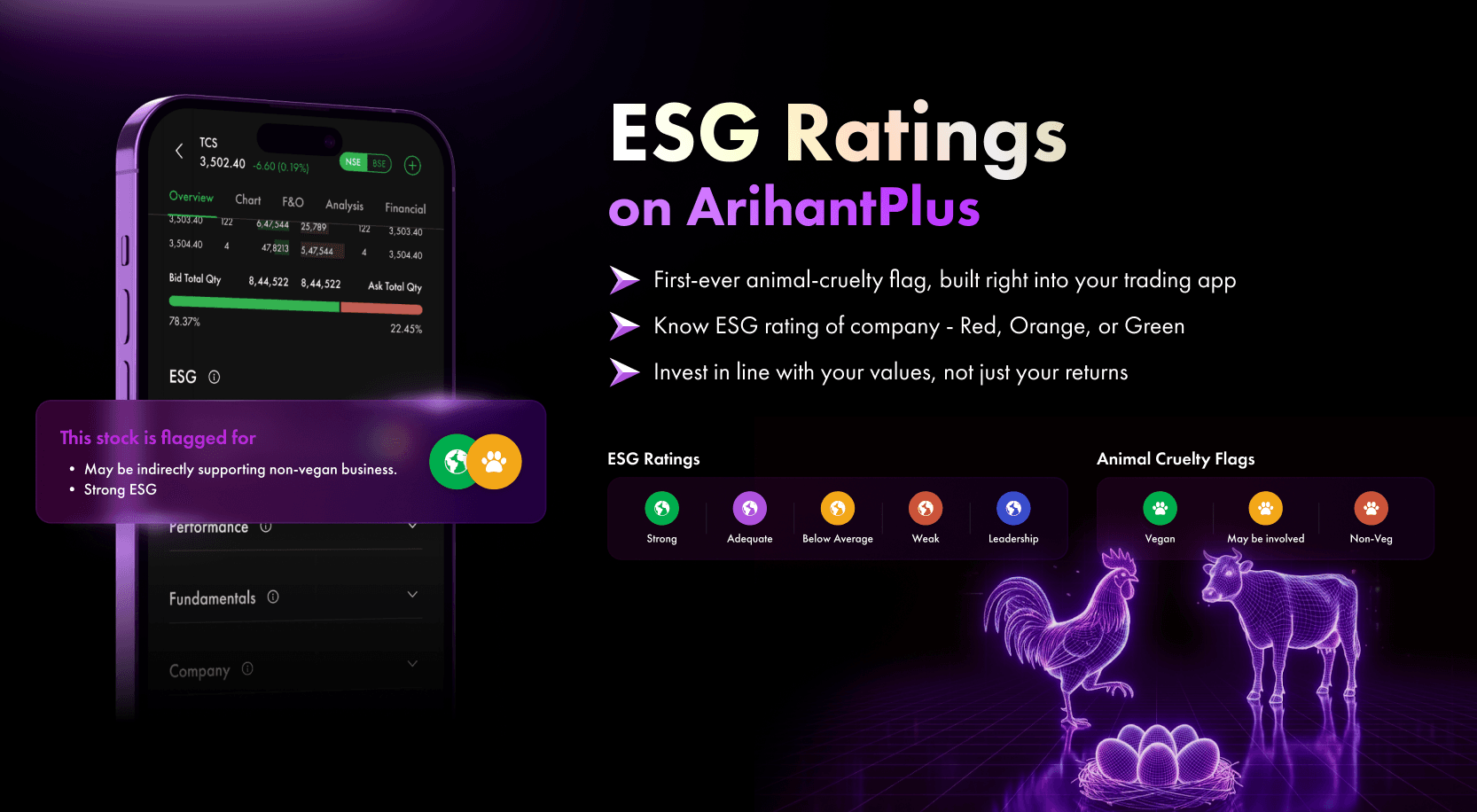
It gives you two independent perspectives on every company:

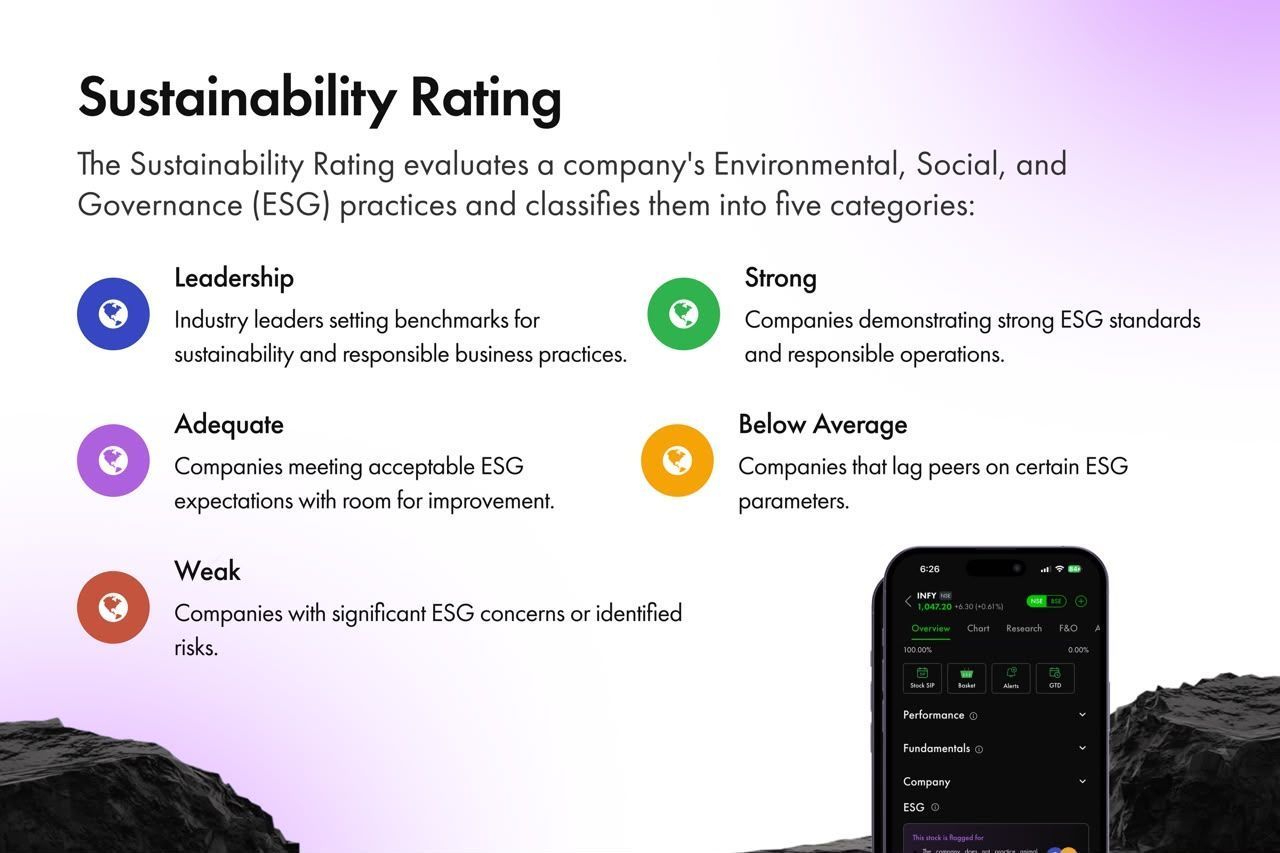
Sustainability Rating

The Sustainability Rating evaluates a company's performance across Environmental, Social, and Governance (ESG) factors.

The rating is presented across five simple bands:

Leadership · Strong · Adequate · Below Average · Weak

This gives you a quick way to understand how a company compares from a sustainability perspective without having to interpret complex raw data.


Animal Cruelty Classification

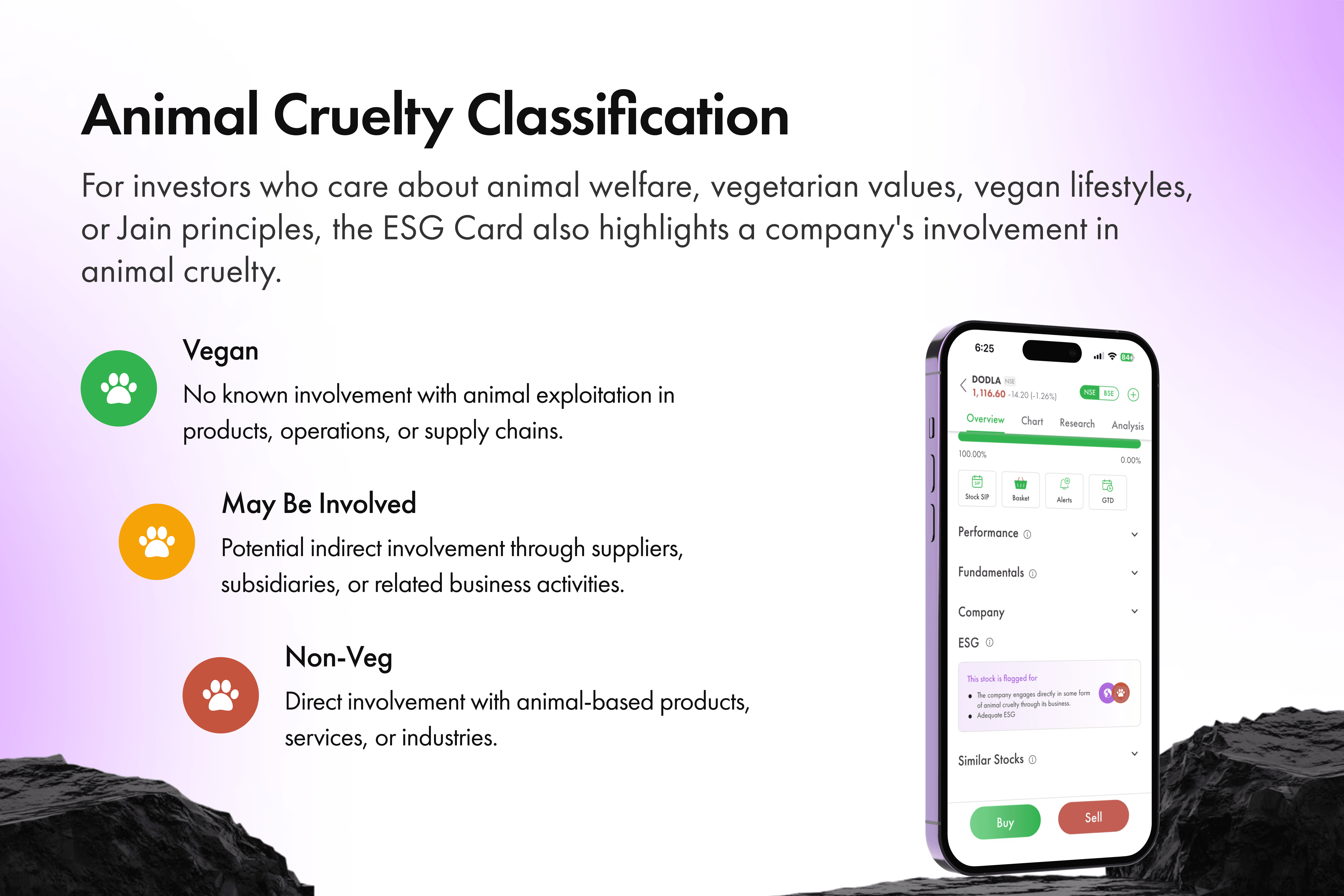
The Animal Cruelty Classification is designed for investors who follow vegan, vegetarian, or Jain principles, or anyone who wants to consider animal welfare when making investment decisions.

Companies are classified as:

Vegan · May Be Involved · Non-Veg

The classification considers a company's direct or indirect connections to animal-based industries.


Why Keep Them Separate?

Because ethics isn't one-dimensional.

A company can perform strongly on sustainability while still having connections to animal-based industries. Another company may have limited involvement with animal-based industries but have a weaker sustainability profile.

That's why the Ethics Card doesn't combine everything into one score.

You get both perspectives, independently and side by side.

What Makes the Ethics Card Useful?

  • On-page visibility: Find ethical and sustainability information directly on the stock page — no digging through lengthy reports.

  • Two independent ratings: Sustainability and Animal Cruelty are evaluated separately so one doesn't hide the other.

  • Five-tier Sustainability Rating: Leadership, Strong, Adequate, Below Average, and Weak make the assessment easy to understand.

  • Built around real ethical considerations: Vegan, May Be Involved, and Non-Veg classifications help investors evaluate companies through different dietary and ethical frameworks.

What Does This Mean for Investors?

The Ethics Card can help you:

  • Spot a values mismatch before you invest, rather than discovering it later.

  • Compare companies beyond financial metrics, by considering ethical and sustainability factors alongside fundamentals.

  • Build a portfolio that better reflects your values, instead of treating your investments as an exception to the principles you follow in everyday life.

One Important Thing to Remember

The Ethics Card is not an investment recommendation.

It doesn't tell you what to buy or what to avoid.

A company with a Weak Sustainability Rating can still be a strong investment, just as a company with a Leadership rating may not be the right stock for your portfolio.

The Ethics Card tells you about the company's ethical and sustainability characteristics not whether its stock is a good investment at its current price.

Your investment decision should always consider factors such as valuation, financial performance, business outlook, risk, and your investment objectives.

Why Is This Different?

Most platforms, when they provide ethical or sustainability information at all, tend to present it as a single combined score.

But ethics isn't always that simple.

By separating Sustainability and Animal Cruelty, the Ethics Card gives you more context and lets you decide which factors matter most to you.

Because the things you care about shouldn't disappear when you open your demat account.

Where We Go From Here

This is just the beginning.

We're looking at expanding Ethics Card coverage across more companies and introducing portfolio-level ethical and sustainability insights, so you can eventually understand not just how individual stocks align with your values, but how your portfolio looks as a whole.

Explore the Ethics Card on Arihant Plus

Open Arihant Plus, visit any stock page, and look for the Ethics Card.

Take a look at the companies you already own or are considering.

Because knowing what you're investing in is about more than knowing the price.

July 16th, 2026

Stop scanning five different sources for one dividend date.

We at Arihant Plus noticed that some of the most important information for your portfolio dividends, bonuses, splits, buybacks, board meeting outcomes has always lived scattered across exchange notices, company PDFs, and news feeds.

The problem investors face today You own a stock. It announces a board meeting. Somewhere in a 40-page PDF is a dividend or bonus decision that directly affects your holding and you find out from a WhatsApp forward, days late. As one trader put it: "I don't need more news. I just need to know what's happening to the companies I actually hold."

Introducing Corporate Actions Corporate Actions is a new dedicated section in Arihant Plus, built around five tabs so you can get to the right view in one tap.

The Feedtab gives you a live feed of every corporate action as it's filed, filterable by Notice, Results, Board Meeting, and Announcement so you can scan just the category you care about.

The AI tab reads every announcement and summarises it in plain language, tagging it Positive, Neutral, or Negative so you know at a glance whether it's worth a closer look.

The Company tab lets you search any stock directly and see all of its corporate actions announcements, AI summaries, and actions in one place, no scrolling required.

The Actions tab shows every corporate action that's recently been added or is approaching its ex-date, filterable by Dividend, Bonus, Split, Rights, and Buyback, with ex-date and record date laid out clearly.

The Deals tab tracks all bulk and block deals, with quantity, price, and value for each.

The Calendar tab gives you a month view with a dot on every date that has an event tap any date and see everything that happened (or is happening) that day, company by company.

What makes it useful

  • Filterable feed: Jump straight to Notices, Results, Board Meetings, or Announcements

  • AI-tagged sentiment: Every announcement is summarized and flagged Positive, Neutral, or Negative

  • Company-level search: Search a stock and see its full corporate action history in one screen

  • Recently added + ex-date tracking: The Actions tab surfaces what's new and what's coming due

  • Bulk & Block deal tracking: See large trades with quantity, price, and value as they happen

  • Date-wise calendar drill-down: Tap any date to see every event that occurred on it

Real benefits for our customers

  • Never miss an ex-date for a dividend, bonus, or split on a stock you hold

  • Spend less time cross-checking exchange PDFs and news sites

  • Get a clearer, AI-assisted read on which company announcements are actually market-moving

Why this feels different Most portfolio trackers show you corporate actions as an afterthought a small tab, buried, with raw exchange text. We've built this as its own section with a filterable feed, a calendar, and AI-summarised sentiment, so it reads like a planner for your portfolio rather than a compliance filing dump.

Where we go from here Next, we're working on personalized alerts so you're notified only for corporate actions on stocks in your own portfolio or watchlist.

Open Arihant Plus and check out Corporate Actions today.

Ratings, sentiment tags, and corporate action data are for informational purposes only and do not constitute investment advice.

July 6th, 2026

New

Smarter screens, cleaner data, and more powerful trading - all in one update.

This release is about refinement. Every feature in 1.0.56 comes from listening closely to how our customers actually use Arihant Plus - and removing the friction that was quietly getting in the way. From a cleaner Trade History to a more powerful Option Strategy builder, version 1.0.56 makes the app sharper across the board.


ESG Card - Know What Your Stocks Stand For

Invest with your values, not just your views.

We have always believed that great investing is about more than returns. With the new ESG Card on Arihant Plus, every stock now carries a values layer - a clean, at-a-glance classification that tells you whether a company's products and practices align with a Vegan or Non-Vegan lifestyle. Open any stock, and the ESG Card is right there on the detail page, quietly adding a dimension that numbers alone never could.

This is built for the growing segment of investors who want their portfolio to reflect more than just financial conviction. Whether you are a conscious investor building an ethical portfolio, or simply curious about what a company actually does, the ESG Card gives you that clarity without making you hunt for it.

It is a small card. But it carries a big idea that the best investment decisions are the ones made with the full picture.


Trade History One Order, One Entry

Your execution history, finally as clean as your thinking.

Until now, when a single order got partially executed across multiple fills, Arihant Plus would show each fill as a separate entry in your Trade History. One order could generate three rows same stock, same direction, different quantities which made reviewing your day's trades unnecessarily cluttered and harder to reconcile at a glance.

Version 1.0.56 fixes this. Partial executions for the same order are now consolidated into a single entry in Trade History. You see the order as one clean line the way you placed it, the way you thought about it. The underlying fill detail is still accessible if you need it, but the default view is now exactly what it should be: clear, organised, and easy to read.

Less clutter. Faster review. A Trade History that actually tells you what happened.


Option Strategy Now Up to 10 Legs

More legs. More precision. More ways to express your view.

When we launched Option Strategy, the 6-leg builder already unlocked multi-leg execution for most standard strategies. But advanced traders kept hitting a ceiling certain payoff structures, ratio combinations, and custom constructions simply could not be built within six legs. Version 1.0.56 breaks that ceiling.

The Strategy Builder now supports up to 10 legs. This means more complex spreads, layered ratio strategies, and highly customised payoff structures are now fully buildable and executable within Arihant Plus in a single order, with the same clean payoff visualisation and breakeven clarity you already rely on.

If six legs gave you the vocabulary, ten legs give you the full language. For traders who think in structures rather than single contracts, this is the upgrade that makes Arihant Plus a serious options desk.


Market Pulse Your Real-Time Market Radar

Stop scanning. Start spotting.

Pulse is a real-time market radar built right into Arihant Plus. It continuously monitors market activity across thousands of stocks and surfaces the ones hitting meaningful levels Day Highs, Week Highs, Month Highs, 52-Week Highs and Lows, and key support and resistance zones. One screen. Every signal that matters.

Before Pulse, discovering opportunities meant opening charts, loading screeners, scrolling watchlists, and burning through the first hour of your session before you even knew where to look. Pulse replaces all of that. The moment a stock hits a level worth noticing, it shows up filtered, clean, and ready to act on.

Available for intraday traders chasing momentum, swing traders tracking emerging trends, and investors who simply want to understand what the market is doing right now. Pulse is not a screener and it is not a watchlist. It is the discovery layer the Arihant Plus trading experience has been missing and it is live in 1.0.56.


Open Arihant Plus, update to version 1.0.56, and experience everything that's new.

July 6th, 2026

New

Stop scanning. Start spotting.

We at Arihant Plus understand something every active trader knows too well - the market creates opportunities every single day. The problem is not that those opportunities are rare. The problem is that by the time most traders discover them, the move has already happened. We built Pulse to change that.

The problem traders face today

Ask any intraday or swing trader how they start their session, and you will hear the same story. Charts open. Screeners load. Watchlists get scrolled. News articles get skimmed. Telegram groups buzz with tips that may or may not be relevant. By the time you have gone through even half of this, the first hour of trading is behind you.

The challenge is not information. Indian markets are drowning in it. The challenge is signal over noise - knowing which stocks deserve your attention right now, without spending twenty minutes to find out. Our customers told us exactly this: 'I know opportunities exist. I just don't know where to look.'

Introducing Pulse - Your Real-Time Market Radar

Pulse is a real-time market radar built right into Arihant Plus. It continuously monitors market activity across thousands of stocks and surfaces the ones hitting meaningful levels - Day Highs, Week Highs, Month Highs, 52-Week Highs and Lows, and key technical support and resistance zones.

You no longer start with a blank screen and a question. You start with a live, filtered view of what the market is actually doing right now. Pulse replaces the tabs, the screeners, the manual scanning - and puts the most relevant signals in one place, the moment they happen.

What makes it useful

  • Day High alerts: Catch stocks hitting their intraday high the moment it happens - momentum's first signal.

  • Week High alerts: Identify stocks that are trending, not just twitching - a level that filters noise from genuine strength.

  • Month High alerts: Discover emerging leaders before they become consensus trades - the sweet spot between early and confirmed.

  • 52-Week High tracking: See which stocks are hitting annual strength peaks - often the beginning of sustained moves.

  • 52-Week Low tracking: Track stocks at their weakest points - useful for contrarian setups and risk management.

  • R1, R2, R3 resistance levels: Monitor the exact levels where selling pressure typically builds - know before the chart shows it.

  • S1, S2, S3 support levels: Track key zones where buying interest tends to appear - plan entries and stops with clarity.

  • Historical signal view: Review past activity to understand how stocks behave at these levels over time.

Feature

Customer Benefit

Marketing Angle

Day High

Spot strength faster

Catch momentum early

Week High

Identify trending stocks

Find what’s moving

Month High

Discover emerging leaders

Stay ahead of the crowd

52W High

Monitor market strength

Follow strong performers

52W Low

Identify weakness

Track market shifts

R1/R2/R3 Levels

Monitor resistance levels

Important levels at a glance

S1/S2/S3 Levels

Monitor support levels

Know key zones instantly

Historical Signals

Learn from past activity

See what mattered before

Real benefits for our customers

  • Stop spending the first 30 minutes of your session just trying to find what to look at.

  • Discover opportunities the moment they emerge, not after they have already moved.

  • Replace five different tools and tabs with one focused, real-time feed.

  • Intraday traders get instant Day High alerts that align with momentum setups.

  • Swing traders get Week and Month High signals that identify emerging trends early.

  • All traders get support and resistance levels that make entries and exits cleaner.

  • Beginners get a guided entry point into market discovery without information overload.

Why this feels different

Pulse is not a screener. A screener requires you to already know what you are looking for - what filters to apply, which parameters to set, which sectors to include. Pulse asks you to do nothing. It watches everything and tells you only what deserves attention, the moment it deserves it.

It is not a watchlist either. A watchlist only shows you stocks you already know about. Pulse surfaces stocks you had not even thought to look at - because their price action, right now, says something worth noticing.

Most platforms give you data. Pulse gives you direction. There is a difference between knowing the Nifty is up 0.4 percent and knowing that a mid-cap stock you were watching just broke its 52-week high with volume. One is information. The other is signal. Pulse is built around signals.

Where we go from here

Pulse launches as a market radar - and that is powerful on its own. But this is just the beginning. We are building toward a version of Pulse that learns your patterns, understands your watchlists and positions, and surfaces the signals most relevant to how you actually trade. More signal types, smarter personalisation, and tighter integration with your discovery-to-execution flow are on the way.

The goal is simple. Every time you open Arihant Plus, Pulse should have already done the scanning, the filtering, and the prioritising - so you can spend your time on what actually matters: deciding and acting.

July 6th, 2026

New

Have a view. Find the strategy. Execute with confidence.

At ArihantPlus, we believe options trading should reward your intuition, not your memory. Most traders already know where they think the market is headed bullish, bearish, rangebound, or about to break out. The hard part is turning that view into the right multileg trade: the right strikes, the right expiries, the right risk. By the time most traders figure that out, the move is gone. Option Strategy is built to close that gap.

The problem traders face today

Options trading is powerful but punishing. Every trade asks you to juggle strikes, expiries, premiums, Greeks, and multileg combinations, in a market that doesn't pause for you to think.

Even experienced traders admit it: they default to plain calls and puts because anything more advanced feels complex. The strategies they've read about spreads, condors, butterflies, ratios stay on the page, never reach the order ticket.

The problem isn't knowledge. It's friction. And the cost is real: most traders lose money in options precisely because they trade naked, single leg positions, leaving themselves exposed to unlimited risk or capped rewards simply because multileg strategies feel out of reach.

Today, we're introducing Option Strategy on Arihant Plus

This is a decision support and execution layer built right into your options trading flow. Instead of asking you to recall the perfect strategy or build one from scratch every time, it starts with the one thing you already have your view on the market and surfaces the strategies that fit.

Pick an outlook: bullish, bearish, neutral, or volatile. The platform instantly shows the strategies designed for that view, complete with payoff charts, break evens, max profit, and max loss all before you commit a single rupee.

When you're ready, the entire multileg trade is placed as a single, coherent order. No legging in manually. No halffilled spreads. And if you want to finetune first, you can still edit any leg remove one, add another and make the strategy your own before placing the order.

For advanced traders who think in payoffs rather than products, the Custom Strategy Builder unlocks openended construction combine calls, puts, longs, shorts, mix expiries and strikes, and engineer exactly the payoff structure you want.

The shift is simple: you no longer memorise strategies. You discover them based on what you actually believe about the market.Here's what makes it useful

Strategy discovery by market direction: Pick bullish, bearish, neutral, or volatile, and the platform surfaces the strategies that fit your view.

  • Bullish: Bull Call Spread, Bull Put Spread, Buy Call, Sell Put, Call Ratio Back Spread

  • Bearish: Bear Put Spread, Bear Call Spread, Buy Put, Sell Call, Put Ratio Back Spread

  • Neutral: Short Iron Condor, Iron Butterfly, Short Straddle, Short Strangle

  • Volatile: Long Straddle, Long Strangle, Call Ratio Spread, Put Ratio Spread, Long Iron Butterfly, Long Iron Condor

Custom Strategy Builder: Build multileg strategies from scratch any combination of calls, puts, longs, shorts, strikes, and expiries. Activate via the Strategy Builder toggle on any index option like Nifty or Bank Nifty, build your payoff curve, test it, tweak it, and execute.

Payoff visualisation: See risk vs. reward, breakeven points, max profit/loss, and funds required clearly laid out before you place the trade.

Singleorder multileg execution: Complex strategies placed as one clean order no legging in, no slippage between legs.

Test, tweak, iterate: Simulate and refine any strategy before committing capital. Edit any leg or add a new one right up until execution.

Real benefits for our customers

  • From market view to order ticket in under a minute

  • Fewer tabs, fewer calculations, fewer mistakes

  • Confidence in every leg see the risk and reward before entering

  • Beginners get guided selection no jargon required

  • Intermediate traders explore structurally and learn by doing

  • Advanced traders get full customisation and payoff optimisation

Why this feels different

Option Strategy isn't another options chain. It isn't a calculator. It isn't an academic toolkit. It's the bridge between what a trader believes and what a trader does turning a market view into a structured trade with full clarity on risk, reward, and outcome before a single rupee is committed.

Think of how it maps to real moments:

  • "I'm bullish on Nifty but want limited risk" → Bull Call Spread

  • "Earnings are coming and I expect a big move" → Long Straddle

  • "Markets feel rangebound this week" → Iron Condor

  • "I'm mildly bearish and want to collect premium" → Bear Call Spread

  • "Volatility is crushed and I want to position for expansion" → Long Strangle

    One sentence. One strategy. One executable order.

    And the difference is tangible. Take a trader who's moderately bullish on Nifty at 22,500. A singleleg buy of the 22,600 Call at ₹180 costs the full premium and loses it entirely if the market doesn't move. A Bull Call Spread buying the 22,600 Call at ₹180 and selling the 22,800 Call at ₹80 cuts net cost to ₹100 per lot, caps the maximum loss at ₹100, and defines the outcome before entry. That's what Readymade Strategies deliver: less risk, defined reward, no surprises.

Where we go from here

Option Strategy is built to grow with you one product, two depths of engagement. Beginners take their first structured trade. Advanced traders engineer payoffs that match their conviction. As markets evolve, so will the strategy library, the visualisation tools, and the intelligence behind them.

Open ArihantPlus, take a view, and place your next options trade with confidence.

July 6th, 2026

New

Hello Traders & Investors,

We hear this often from our users:

"I want to use AI for my investments, but it doesn't know anything about my actual portfolio."

That's the core problem. AI tools like Claude, ChatGPT, and Perplexity are powerful — but until now, they had no idea what stocks you hold, what your F&O exposure looks like, or how your portfolio is performing. The advice was smart, but never personal.

That changes today.

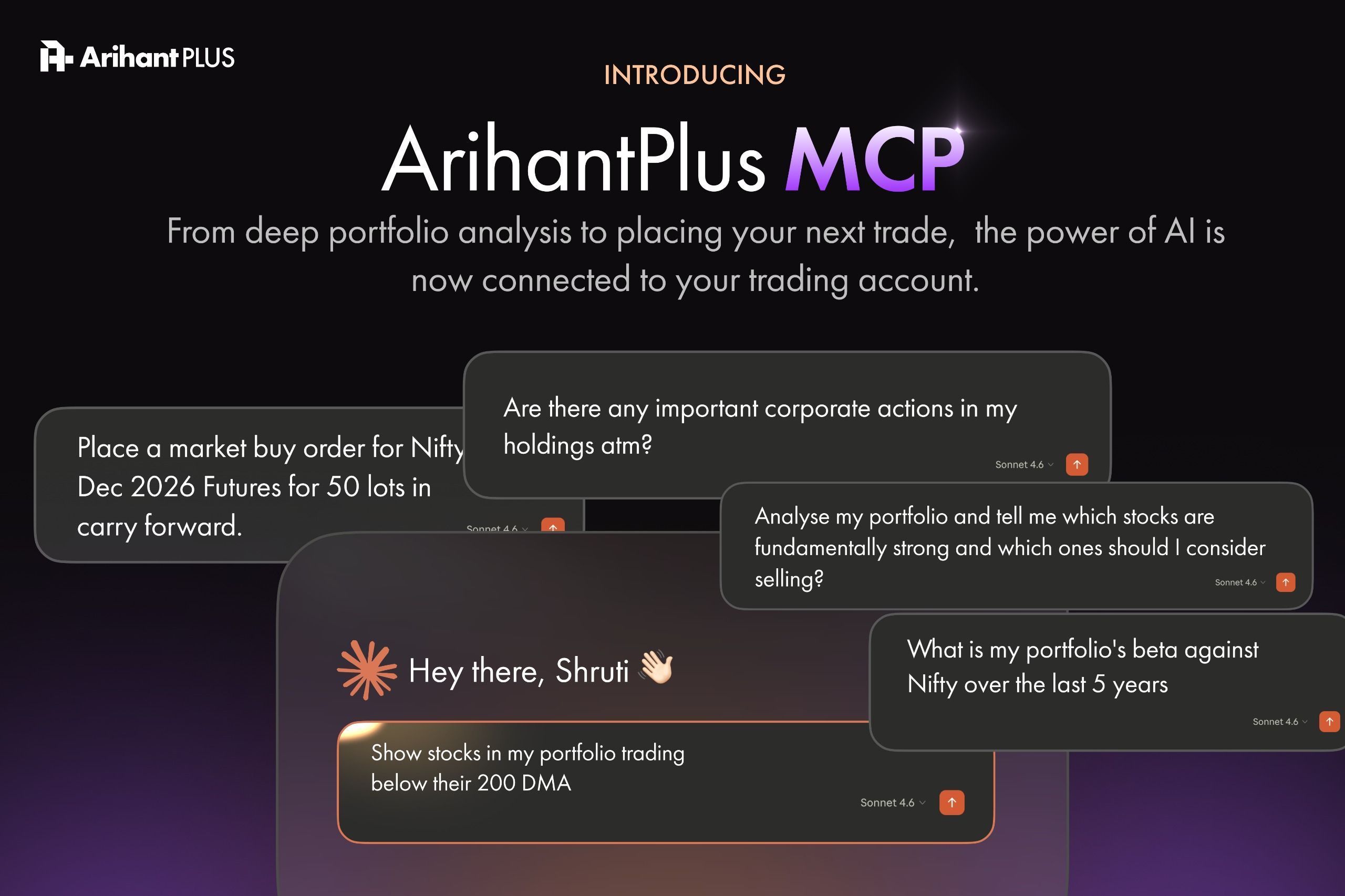
Introducing ArihantPlus MCP — a secure bridge that connects your ArihantPlus trading account directly with AI assistants. No coding. No complex setup. Ready in under 3 minutes.

Claude x ArihantPlus MCP - Connect your AI assistant with AI assistant Claude.jpeg

What you can do with it:

Once connected, just chat with your AI assistant naturally:
"Show me my top 5 performing stocks this quarter" "Am I overexposed to mid-caps?" "Which of my F&O positions are expiring this week?" "Buy ₹10,000 worth of HDFC Bank at market price"

Your AI now has full context — your holdings, your positions, your trades — and can analyse, explain, and act on them in real time.

A few things worth knowing:

  • Works with Claude, ChatGPT, Perplexity, Cursor, and more

  • Live portfolio sync — no tab switching, no manual data entry

  • End-to-end encrypted; you can revoke access anytime

  • Full audit trail of every action the AI takes on your account

This is not just a feature add. For the first time, AI can give you advice that's actually built around you — your holdings, your risk, your goals.

We'd love for you to try it and share your feedback. There's a lot more we're building on top of this.

Read complete details of ArihantPlus MCP along with step-by-step on how to connect your AI assistant with your AirhantPlus trading account here or watch YouTube video guide here.

Happy Investing! 🚀

July 6th, 2026

Expert calls, model portfolios, and ideas - right where you trade.

We at Arihant Plus believe every retail investor deserves access to the same quality of research that institutions enjoy. Knowledge should not be a privilege - it should be the starting point of every trade. That conviction shaped our new Research Subscription Module.

The problem traders face today

Good research is everywhere on the internet - newsletters, PDFs, WhatsApp groups, paywalled sites. The trouble is, by the time you find a credible call, copy the stock name, switch to your broker, and act on it, the entry price is gone.

Customers told us they want one trusted place where research and execution live side by side.

Introducing Research Subscription Module

We are bringing professional research inside Arihant Plus through our new Research Subscription Module. Pick a plan that fits your style - from short-term trading calls to long-term investment ideas - and act on it with a single tap.

It is research designed to be used, not just read.

What makes it useful

  • Multiple subscription tiers: Choose between Intraday, Positional, Long-term, and Mutual Fund advisory packs.

  • One-tap execute: Place the recommended trade with target and stop loss already filled in.

  • Live tracking: See open calls, closed calls, and performance history transparently.

  • Instant alerts: Notification the moment a new call is published or modified.

  • Model portfolios: Mirror an entire portfolio with proper weights in a few taps.

Real benefits for our customers

  • Stop hunting across PDFs and Telegram groups.

  • Execute calls at the right price, at the right time.

  • Full transparency into past performance - no cherry-picking.

  • Beginners get curated guidance; experienced traders get sharper signals.

Why this feels different

Most platforms either sell research or offer trading. Arihant Plus does both - and connects them so the gap between idea and action almost disappears.

Where we go from here

Quality research is the unfair advantage every retail investor deserves. We will keep adding new advisors, themes, and asset classes inside this module.

Open Arihant Plus and explore our research plans today.